The webinar is a proven tool for B2B marketing — you can repurpose the content, collect emails, and show expertise. But it has three weaknesses that increasingly slow it down for lead generation: a fixed time, one-way delivery, and high no-show. This article fairly compares a webinar with an interactive demo the prospect launches themselves, and advises when to choose which — and how to move from one to the other without risk.
What a webinar does well (let us be fair)
A webinar has undeniable strengths. A live host builds trust, you can show depth of a topic, and one well-recorded session then serves for months as content. For brand building, educating the market, or presenting to a larger group, it is still a strong format.
It also works as a contact collector: registration equals an email in the database. And when the topic lands, it can attract people who would not reach out on their own. Nobody takes that away from the webinar.
The problem arises when you expect mainly qualified leads ready for a sales conversation from the webinar. That is where it starts hitting its limits.
Where a webinar loses leads
Fixed time. The webinar runs Tuesday at 10:00. Whoever has a meeting, is in a different time zone, or thinks of the topic on Thursday evening is out of luck. Interest arrives continuously, the webinar is a point in time — and that mismatch costs leads.
High no-show. For free webinars, a large share of registrants commonly do not show up. They register with good intent but have another priority at that time. You do send the recording, but a recording is again just a one-way video.
One-way delivery. 45 minutes of generic content, of which perhaps five are relevant to a specific person. Their specific question often does not fit into the Q&A at the end — and even if it does, most people do not want to ask in front of a hundred others. They leave without the answer they needed to decide.
Scales only in slots. Want to reach more people? You have to run another webinar. Capacity is tied to the calendar, not to demand.
An interactive demo as a webinar alternative
An interactive demo solves exactly those three weaknesses. It is a product walkthrough the prospect launches themselves — any time, with no slot registration — and one that holds a conversation with them. Instead of listening to 45 minutes of generic content, they get answers to exactly what they care about in a few minutes. This is precisely how an
interactive AI product presentation works.
No fixed time means no no-show: whoever clicks is inside. No one-way delivery means the prospect can ask any time and get an immediate answer — without the shyness they feel in front of a group. And because it runs itself, it scales without limit: it serves one prospect or a hundred at once, day and night.
For you, the difference is mainly at the output. From a webinar you leave with a list of emails. From an interactive demo you get, for each prospect, a transcript of the conversation, the topics they asked about, their objections, and a qualification score — you know who to call first.
Webinar vs. call vs. interactive demo — a direct comparison
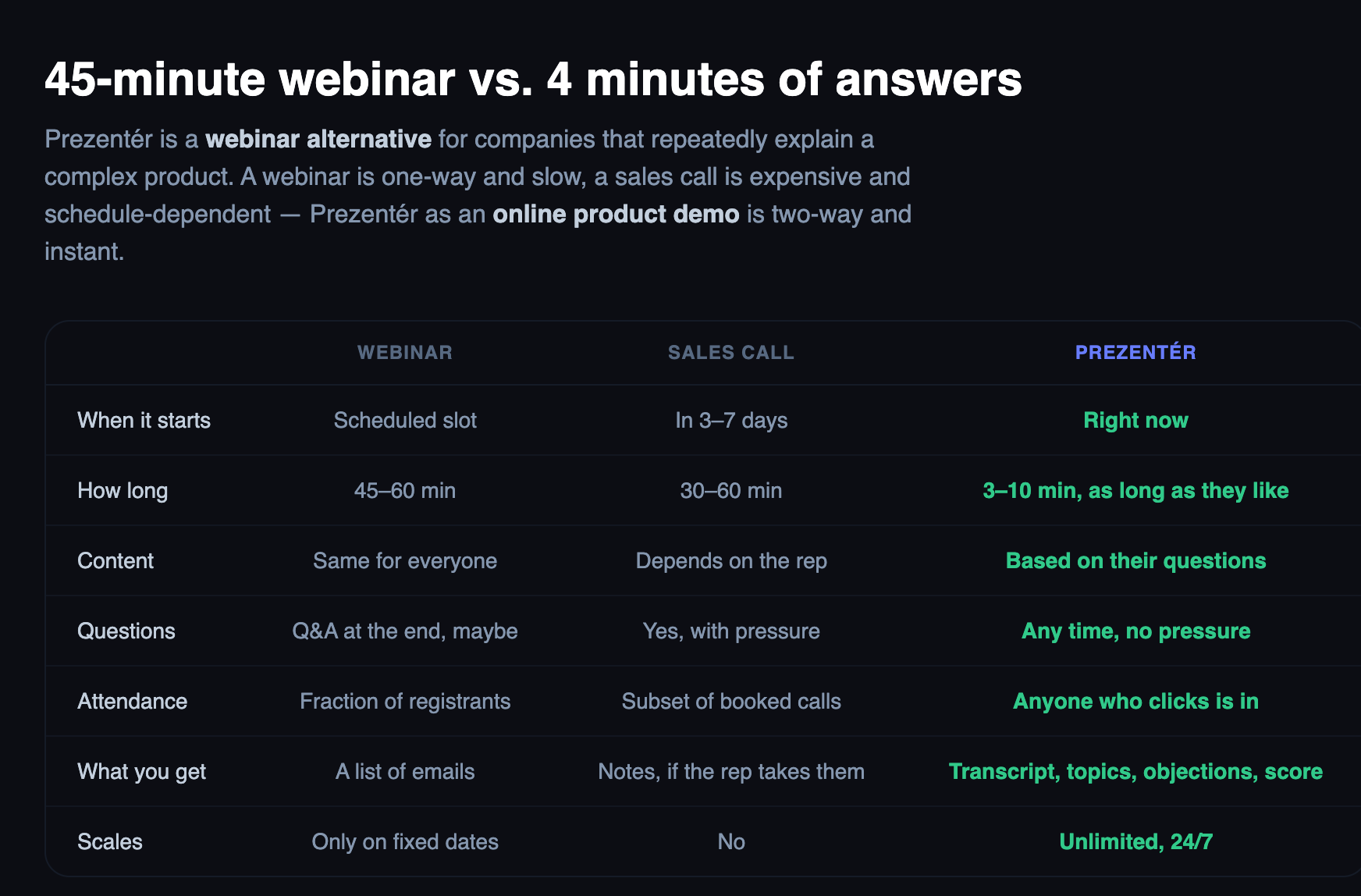
The three formats side by side by what they actually do for generating and qualifying leads:
| Criterion | Webinar | Sales call | Interactive demo |
|---|
| When it starts | By slot | In a few days | Right now |
| How long | 45–60 min fixed | 30–60 min | 3–10 min, prospect-led |
| Content | Same for everyone | Depends on the rep | Based on the prospect questions |
| Questions | Q&A at the end, maybe | Yes, with pressure | Any time, no pressure |
| No-show | High | Medium | None (whoever clicks is in) |
| What you get | A list of emails | Notes, sometimes | Transcript, topics, objections, score |
| Scales | Only in slots | No | Unlimited, 24/7 |
No format is universally best. But for quickly qualifying a prospect who wants to see the product now, an interactive demo has the least friction.
When to choose a webinar and when a demo
A webinar makes sense when you educate the market, build the brand, address a broad topic in front of a larger group, or want to get long-term content out of a single appearance. It is a tool for the top of the funnel and for building authority.
An
interactive demo wins when the prospect already knows they have a problem and wants to see a specific solution — with no waiting and no commitment to a meeting. It is a tool for the decision stage and for fast qualification. When you are choosing the demo format itself, read
how to create an online product demo.
In practice they often complement each other: the webinar attracts and educates, the interactive demo then leads individual prospects to a qualifying step at their own pace. You do not have to choose one or the other — but for generating leads from existing traffic, a demo tends to be more effective.
If you are deciding how to create the interactive option, see the practical guide to a
self-serve product demo.
How to move from a webinar to a demo without risk
You do not have to cancel anything or bet blindly. The cleanest path is a test: offer part of your visitors "launch the interactive demo now" and the other part "book a meeting" or "register for the webinar". On your own numbers you will see how many people actually enter the demo and how many of them reach a qualifying step.
You decide on data, not on a hunch. For products with a longer decision cycle and repeated explaining, the demo usually wins on throughput — more people launch it because it requires no slot or registration. For purely educational content, the webinar stays in place.
Want a demo prospects run themselves?
Prezentér is an interactive product demo — it walks prospects through, answers questions by voice or text, and hands you a qualified lead. No waiting for a meeting.